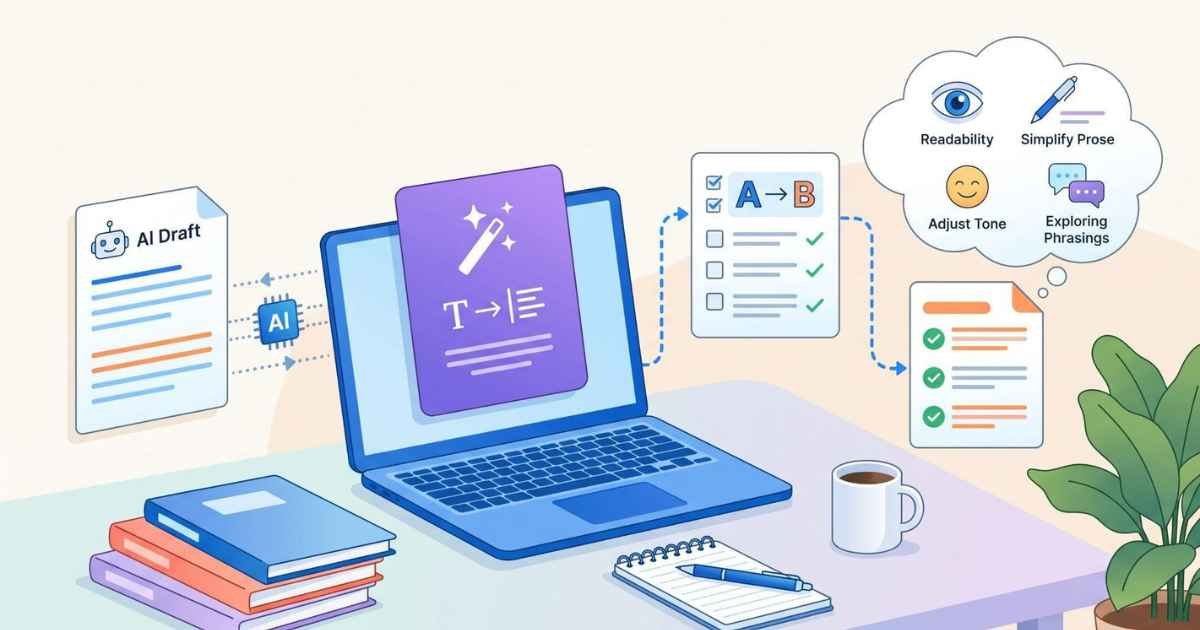
A humanizer is a tool designed to make text sound more natural, conversational, or less repetitive. In writing, the term often refers to software that rewrites AI-generated or AI-assisted content by changing its wording, sentence structure, and style.
Interest in text humanizers has grown alongside the use of AI writing assistants. People want to work faster without ending up with content that feels generic or disconnected from their own voice. But what does a humanizer actually change, and when is using one worthwhile?
Understanding how these tools work can help you decide whether they belong in your writing process.
What Is a Text Humanizer?
A text humanizer takes existing writing and produces an alternative version intended to read more naturally. Depending on the tool, it may replace words, reorganize sentences, adjust paragraph structure, or change the overall tone.
For example, an original sentence might read:
“Utilizing effective communication strategies can facilitate improved collaboration among team members.”
A simpler alternative could be:
“Clear communication helps team members work together more effectively.”
The revised sentence is shorter and easier to follow, although the best choice depends on the intended audience and context.
A humanizer can suggest changes like these at scale, potentially saving time during editing. However, changing the wording does not automatically improve the substance of the text. The writer still needs to determine whether the new version communicates the right idea.
How Does a Humanizer Work?
Humanizers do not all use the same technology. Their methods can vary according to how the software was designed.
Rule-Based Rewriting
Some tools rely on predefined substitutions and transformation rules. They may replace selected expressions, rearrange phrases, or make predictable changes to sentence structure.
This approach can work for simple edits, but it may produce awkward wording when the original sentence requires more context or a nuanced interpretation.
AI-Powered Rewriting
Other humanizers use language models to generate alternative versions of a passage. These systems can make broader changes to vocabulary, sentence structure, tone, and phrasing.
Because the model generates new wording based on context, the result may be more flexible than a simple word-substitution process. However, the output can still introduce errors, change the original meaning, or remove important details.
Style and Readability Adjustments
Some tools focus on a particular writing goal, such as making text more conversational, simplifying complicated sentences, or reducing repetitive phrasing.
These features can be useful when a draft has a clear stylistic problem. They should not be confused with fact-checking, plagiarism checking, or proof of authorship, which are separate tasks.
For a more detailed explanation of the technology, see this guide to what an AI humanizer is and how it works.
Why Do People Use Humanizers?
A humanizer can serve several purposes, depending on the writer’s needs.
Improving readability. Long or complicated sentences can be difficult to follow. Rewriting tools may offer simpler alternatives that make the text easier to understand.
Reducing repetitive wording. When a draft repeatedly uses the same expressions or sentence patterns, a humanizer can generate different ways to communicate the same idea.
Adjusting tone. A formal draft may need a more conversational style for a blog post, newsletter, or general audience. A rewriting tool can suggest alternatives.
Speeding up editing. Writers working with large amounts of text may use humanizers to produce alternative versions quickly, then review the results manually.
Exploring different phrasings. Sometimes a sentence is technically correct but sounds awkward. Seeing another version can help a writer identify a clearer way to express the idea.
The value depends on the result. If a tool makes the writing longer, less accurate, or harder to understand, the revision may not be an improvement.
Humanizer vs. Paraphrasing Tool
Humanizers and paraphrasing tools overlap, but their intended emphasis can differ.
A paraphrasing tool generally focuses on expressing existing information in different words while preserving its central meaning. A humanizer typically emphasizes naturalness, tone, readability, or variation in writing style.
In practice, the distinction is not always clear. Some products offer both types of rewriting, and their capabilities depend on the particular tool.
Neither type of software guarantees that the result is original in the legal or academic sense, factually correct, or properly attributed. Rewording someone else’s work does not remove the need to cite sources where citations are required.
Can a Humanizer Improve AI-Generated Content?
It can improve certain aspects of a draft, but the outcome depends on what needs fixing.
If the text contains repetitive phrases or awkward sentence structures, a humanizer may provide useful alternatives. If the article lacks evidence, original insight, or a logical argument, rewriting alone is unlikely to solve those problems.
Consider two versions of a statement:
- Generic: “Businesses should use technology to improve their operations.”
- More specific: “A small retailer can reduce manual stock checks by using inventory software that updates quantities after each sale.”
The second example is more useful because it identifies a particular business, process, and potential benefit. Its strength comes from specificity, not simply from sounding more conversational.
The best results often come from combining automated rewriting with careful editing, relevant examples, and fact-checking.
The Limitations of Humanizer Tools
Before relying on a humanizer, consider several important limitations.
Meaning can shift. Replacing words or restructuring a sentence may change a qualification or make a claim sound more certain than intended.
Factual errors can remain. A humanizer may preserve an incorrect statement or introduce a new error. Important facts should be checked against reliable sources.
Personal experience cannot be manufactured. A tool can rewrite information you provide, but it cannot reliably supply genuine firsthand experience that you have not shared.
Writing may still sound generic. Different wording does not necessarily create a distinctive perspective or make an article more useful.
Privacy matters. Before uploading unpublished or confidential material, review the service’s data-handling and privacy policies. Avoid sharing sensitive information unless you have authorization and understand the risks.
These limitations are particularly important when editing academic work, technical documents, professional reports, or content that may influence consequential decisions.
Do Humanizers Help With AI Detectors?
Some people use humanizers because they want AI-generated writing to receive a lower AI detection score. However, no humanizer can guarantee a particular detector result.
AI detectors estimate whether writing resembles patterns associated with machine-generated content. Different systems use different approaches, so the same passage can receive different results from different tools.
Human-written text can also be incorrectly flagged. A changed detection score does not prove that a person wrote the revised passage, just as a high score does not conclusively establish AI authorship.
Writers should therefore focus on accuracy, originality, clarity, and compliance with applicable rules rather than trying to obtain a particular score. If an institution, employer, or publisher requires disclosure of AI assistance, rewriting the text does not remove that requirement.
How to Use a Humanizer Effectively
A practical workflow can help you get useful results without giving up control of the final writing.
- Start with a clear draft. Make sure the main ideas are accurate and organized before rewriting.
- Identify the problem. Decide whether you need simpler language, less repetition, a different tone, or better sentence flow.
- Test a short passage. Try rewriting one section before applying the tool to an entire article.
- Compare the versions. Check whether the revised text is clearer and whether the meaning has changed.
- Add specific details. Include relevant examples, evidence, and your own analysis where appropriate.
- Fact-check the final draft. Verify names, dates, figures, and important claims.
- Read it aloud. Correct anything that sounds unnatural or does not fit the intended audience.
A humanizer is most useful when it solves a specific writing problem. Using one automatically on every paragraph can create unnecessary work and introduce changes that make the text worse.
Final Thoughts
A humanizer can help writers explore alternative wording, improve readability, and reduce repetitive phrasing. Its effectiveness depends on the tool, the original text, and the care taken when reviewing the output.
It cannot guarantee accuracy, originality, or a distinctive personal voice. Those qualities require more than a change in wording.
Use humanizers as editing assistants rather than automatic replacements for judgment. When combined with specific ideas, reliable information, and careful revision, they can become a useful part of a writing workflow.
For more practical guides and explanations about technology and AI, visit OpenHerald.
Disclaimer: The information in this article is for general informational purposes only and does not constitute professional, legal, academic, or technical advice. Humanizer tools, AI detection systems, and platform policies vary by provider and may change without notice. No humanizer can guarantee accuracy, originality, or a specific AI detection result. Readers should verify all factual content against reliable sources, follow applicable academic or professional disclosure requirements, and review privacy policies before uploading unpublished or confidential material. Any mention of specific tools, services, or websites does not imply endorsement. The author and publisher disclaim any liability for decisions made based on this content.