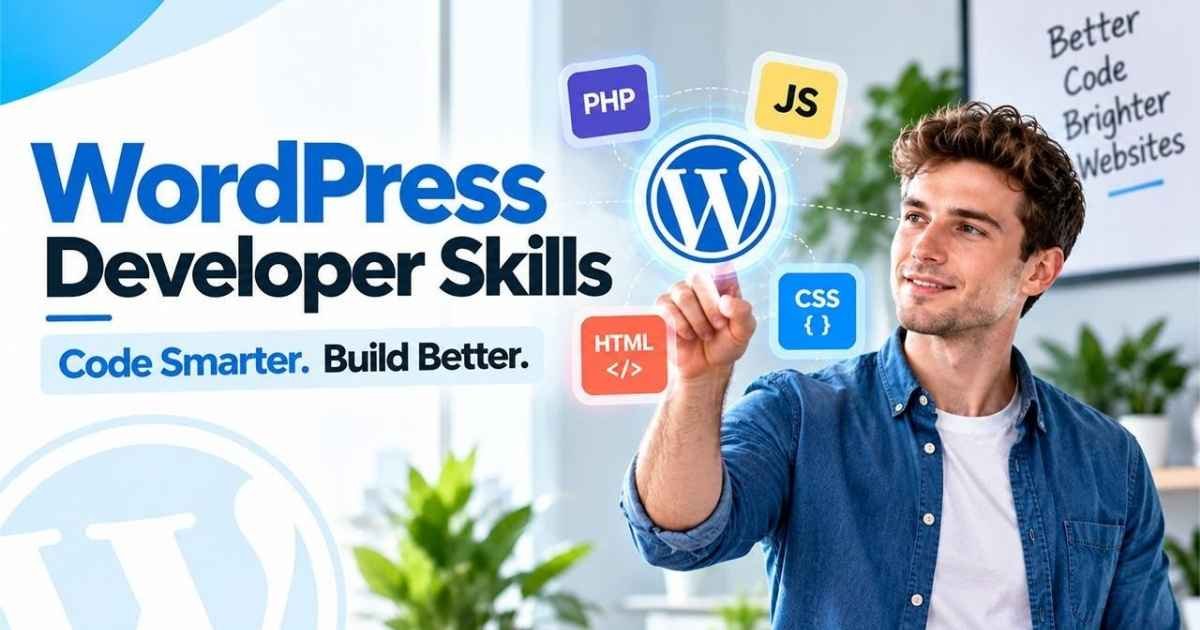
The guide explores the essential coding skills that every WordPress developer should practice and also explains how improving these skills can help users become more capable developers.
WordPress powers a large portion of all the websites across the web, making WordPress development a valuable and competitive career path. However, becoming an effective WordPress developer generally involves much more than just knowing how to install WordPress, choosing a theme, or using plugins. Strong fundamentals allow developers to build secure, fast, flexible, and maintainable websites.
Practicing the right WordPress developer skills can offer a significant difference, whether the user is starting a career in development or looking to improve their existing abilities. Each skill, from HTML and CSS to PHP and APIs, contributes to the ability to solve real-world development challenges.
What are WordPress Coding Skills?
WordPress coding skills are a set of technical abilities developers use to create, customize, maintain, and improve WordPress websites. The coding skills go beyond simply using the WordPress dashboard or installing themes and plugins. A skilled WordPress developer can understand how to write and modify code to build websites that are secure, functional, and easy to maintain.
There are various important WordPress coding skills, such as HTML, CSS, PHP, JavaScript, SQL/MySQL, WordPress hooks, WordPress APIs, and GIT, among others. Strong WordPress developer skills allow developers to achieve more than basic website changes. With advanced coding skills, developers can build custom themes and plugins, integrate third-party services, optimize performance, troubleshoot technical problems, and create solutions tailored to specific business requirements.
Benefits of WordPress Coding Skills?
Developing strong WordPress coding skills generally offers several advantages for developers, businesses, and website owners. Some of the key benefits of WordPress coding skills are as follows:
- Greater Website Customization
Advanced coding skills allow developers to customize themes, plugins, layouts, and functionality according to specific requirements. Instead of depending on pre-built solutions, developers can create unique features and designs for websites.
- Ability to Build Custom Themes and Plugins
With knowledge of PHP, HTML, CSS, and JavaScript, developers can create custom WordPress themes and plugins. It is particularly useful when existing plugins or themes cannot offer the required functionality.
- Better Website Performance
Understanding how WordPress code works helps developers identify any unnecessary scripts, inefficient queries, and poorly written code.
- Improve Security
Coding knowledge also helps developers recognize common security risks and implement safer practices, such as input validation, data sanitation, output escaping, and proper user-permission checks.
Top WordPress Developer Skills for 2026
Some of the key WordPress developer skills are as follows:
- Mastering HTML and Semantic Markup
HTML acts as the foundation of every WordPress website. Although WordPress can generate much of the HTML automatically, developers still need to understand how markup works to create and customize themes, templates, blocks, and components. A good WordPress developer should be comfortable with Semantic HTML5 elements, forms and input fields, links, images and multimedia, headings and document structure, accessibility-friendly markup, and HTML attributes and data attributes.
- Develop Strong CSS Skills
CSS is another key component of the Skills for WordPress Developer toolkit. WordPress websites frequently require custom styling, whether the user is creating a theme from scratch or modifying an existing design. Developers should practice CSS selectors and specificity, Flexbox, CSS Grid, responsive design, media queries, positioning, transitions and animations, CSS variables, and mobile-first development.
- Learn PHP Thoroughly
PHP is among the most important WordPress developer skills, as WordPress is primarily built with PHP. Developers do not need to become a PHP language expert before working with WordPress, but they should have a solid understanding of its fundamentals. They should practice concepts such as variables and data types, conditional statements, loops, functions, arrays, classes and objects, namespaces, error handling, and object-oriented programming.
- Understanding WordPress Hooks
Hooks are the central element of WordPress development. Hooks allow developers to modify or extend WordPress functionality without directly editing the core files of the platform. There are two major types of hooks: Action hooks allow developers to execute custom code at specific points, whereas Filter hooks allow them to modify data before it is displayed or processed.
- Build Practical JavaScript Skills
JavaScript has become increasingly essential in WordPress development. Modern WordPress experiences generally rely on JavaScript, especially when working with the block editor and interactive interfaces. Developers should understand variables and functions, arrays and objects, events, DOM manipulation, JSON, promises and asynchronous programming, Fetch and AJAX, and modern JavaScript syntax.
- Learn WordPress APIs
WordPress offers several APIs that developers should understand. These APIs enable developers to extend functionality and connect WordPress with other systems. Some important APIs include REST API, Settings API, Plugin API, Metadata API, Option API, Transients API, and HTTP API. The REST API is especially useful for modern applications and integration. It enables external applications to communicate with WordPress and retrieve or modify data.
- Understand MySQL and Database Concepts
WordPress stores content and configuration data in a MySQL-compatible database. Developers should understand how WordPress stores and retrieves information, but do not need to become a database administrator. They can understand concepts like tables and relationships, primary keys, Indexes, SQL queries, SELECT, INSERT, UPDATE, and DELETE, Database optimization, and Data sanitization.
Understanding the WordPress database structure can be helpful, especially when debugging complex issues.
- Practice Git and Version Control
Git is an essential development skill. Professional WordPress development often involves multiple developers, staging environments, production deployments, and ongoing changes. WordPress developers should practice creating repositories, making commits, creating branches, merging branches, resolving conflicts, and reviewing changes.
- Learn Debugging and Error Handling
Writing code is only considered a single part of development; debugging is also equally essential. WordPress developers regularly encounter PHP warnings, JavaScript errors, plugin conflicts, database issues, styling problems, and unexpected behavior. Developers should develop a systematic debugging process, which includes reproducing the problem, identifying when the problem occurs, checking browser developer tools, reviewing PHP and WordPress logs, isolating conflicting code, testing one change at a time, and confirming the solution before deploying it.
- Prioritizing Security
For a developer, security should be a crucial part of every WordPress coding process. Developers should understand common risks, such as SQL injection, Cross-site scripting (XSS), cross-site request forgery (CSRF), unauthorized access, unsafe file uploads, and insecure API endpoints.
- Practice Clean and Maintainable Code
One of the most valuable skills for WordPress Developer professionals is the ability to write code that other developers can understand. Clean code generally means clear naming conventions, small, focused functions, minimal duplication, useful comments, logical file organization, and appropriate abstraction. Developers should also avoid writing unnecessarily complicated solutions.
- Improve Performance Optimization Skills
The performance of the website directly affects user experience. WordPress developers should understand how their code can influence loading speed and server resources. Developers should practice techniques like writing efficient PHP, minimizing unnecessary database queries, optimizing images, loading scripts and styles appropriately, using caching effectively, avoiding inefficient loops, and optimizing database operations.
Developers can explore the best coding kata sites to find challenges at different difficulty levels and practice writing cleaner solutions. For WordPress developers, practicing PHP and JavaScript katas can reinforce the programming fundamentals needed to work with themes, plugins, APIs, and custom functionality.
A Practical Approach to WordPress Setup and Optimization
For WordPress developers, coding skills are only one part of building a reliable website. The initial setup, security configuration, performance optimization, and ongoing maintenance also influence the quality of the final website. WP-1Click takes a security-first and performance-focused approach to WordPress deployment, automating tasks such as WordPress configuration, initial security settings, and performance optimization. This can help developers and website owners start with a more structured environment while allowing developers to focus their coding skills on customization, functionality, and solving project-specific requirements.
Best Practices for WordPress Developers
Following best practices help WordPress developers create websites that are secure, fast, scalable, accessible, and easy to maintain.
Some of the best practices that every WordPress developer should follow are as follows:
- Follow WordPress Coding Standards
Developers should use consistent formatting, naming conventions, documentation, and coding patterns. Following WordPress coding standards makes your code easier for other developers to read, review, and maintain.
- Avoid Editing WordPress Core Files
Developers should never modify WordPress core files directly. Core files can only be overwritten when WordPress is updated. They should use themes, child themes, plugins, actions, and filters to customize functionality.
- Use Hooks Properly
Actions and filters are fundamental to WordPress development. They allow developers to extend or modify WordPress functionality without changing core code.
- Prioritize Security
Security should be considered whenever a developer handles user input or displays stored data. Developers should practice sanitizing incoming data, validating user inputs, escaping output, using WordPress nonces when appropriate, checking user capabilities, and avoiding unsafe database queries.
Conclusion
Strong coding fundamentals are considered essential for building secure, fast, flexible, and maintainable WordPress websites. By practicing HTML, CSS, PHP, JavaScript, APIs, database concepts, Git, debugging, and performance optimization, developers can strengthen their WordPress development skills and handle increasingly complex projects with confidence. Consistent practice, clean coding habits, and a focus on real-world problem-solving can help both aspiring and experienced WordPress developers build better websites and grow their development careers.
Frequently Asked Questions
Q:1 Is PHP necessary for WordPress development?
Yes, PHP is necessary for WordPress development. It is essential because WordPress is primarily built with PHP.
Q:2 Do WordPress developers need to know JavaScript?
Yes, WordPress developers need to know JavaScript. JavaScript is increasingly important for creating interactive WordPress websites and working with modern WordPress features.
Q:3 Do I need to learn SQL to become a WordPress developer?
No, developers only need to have basic SQL and database knowledge to become WordPress developers.
Q:4 How can I improve my WordPress coding skills?
You can improve by building real-world WordPress projects, practicing PHP and JavaScript, working with APIs and hooks, debugging existing issues, reviewing your code, and regularly solving coding challenges.
Disclaimer: The information provided in this article is for general informational and educational purposes only. It does not constitute professional web development, technical, or career advice. WordPress technologies, coding standards, and best practices evolve continuously; readers should verify current documentation and test approaches in their own development environments. The mention of specific tools, platforms, or services (including WP-1Click) is illustrative and does not imply endorsement. The author and publisher disclaim all liability for any technical issues, security vulnerabilities, project outcomes, or career decisions arising from reliance on this content. Always follow official WordPress documentation and security guidelines. This article does not guarantee specific skill development or career results.
Get inspired by stories of quiet triumph—our triumph tales prove that victory comes in many forms.