AI can solve real business problems. But a promising use case does not make a strong investment case.
84% of finance organizations have implemented or plan to implement AI. Yet only 7% reported payback from an AI use case within one year.
That gap creates a practical question: Who should evaluate the investment before more money goes in?
- A CFO sees the financial case.
- A CTO sees the technical reality.
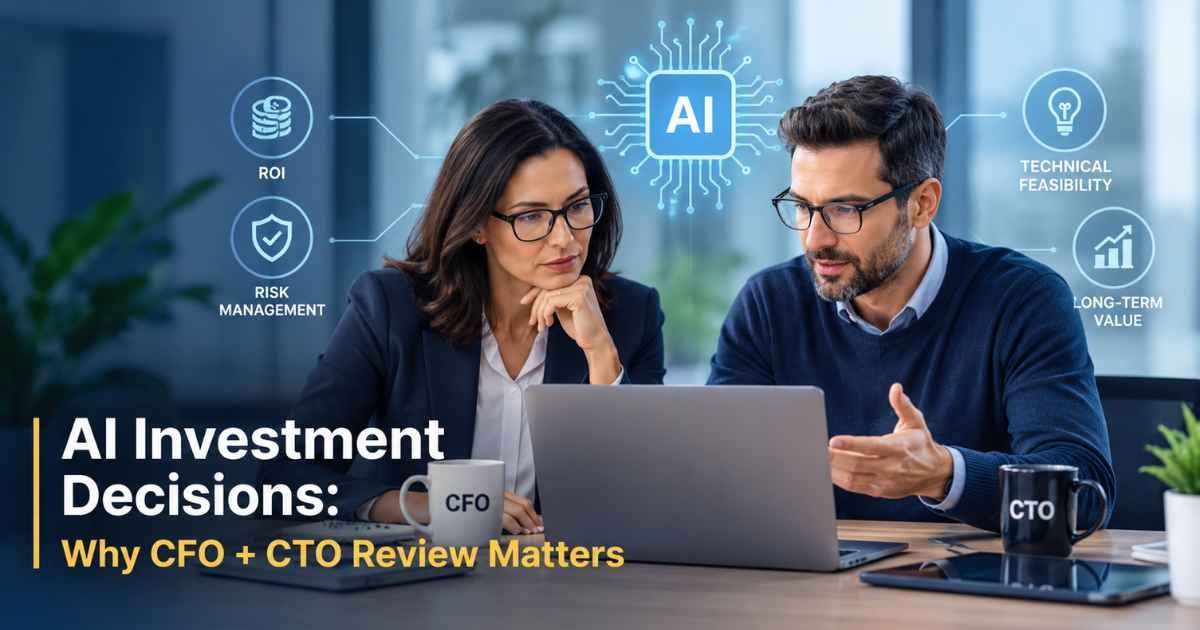
Both views matter before an AI initiative moves forward. A practical AI investment case needs both perspectives, not just a promising use case. The real test is whether the expected business value can be delivered, measured, and sustained.
Why AI Investment Decisions Need Two Perspectives
AI investments affect more than the technology budget.
They can change workflows, infrastructure, data needs, and operating costs. They can also introduce security and governance requirements.
A CFO needs to understand:
- What will the investment cost?
- What value can it create?
- When should that value appear?
- How will ROI be measured?
A CTO needs different answers:
- Is the required data ready?
- Can the solution integrate with existing systems?
- Can it scale beyond the pilot?
- What security and governance controls are needed?
What the CFO Needs to Validate
For finance leaders, the first concern is not the technology itself. It is whether the investment makes business sense and supports a clear outcome. The CFO’s role is to validate the financial case before committing more capital, including understanding the real cost of AI coding beyond software licenses or developer productivity gains.
The CFO should validate:
- Business outcome: What problem will the AI initiative improve?
- Measurable value: How will the expected improvement be measured?
- Business priority: Does the initiative support a clear business goal?
- Full investment: Are data, engineering, integration, infrastructure, and operating costs included?
- Payback: Are the expected returns and payback assumptions realistic?
- ROI measurement: How will the actual return be tracked?
- Key assumptions: Which assumptions drive the expected financial return?
- Investment risk: What could reduce the expected value?
What the CTO Needs to Validate
Technical feasibility can change the financial case. The CTO needs to determine whether the solution can work, integrate, and scale as planned. The CTO’s role is to identify technical gaps before they increase investment risk.
The CTO should validate:
- Data readiness: Does the required data exist and support the use case?
- Architecture: Can the current or planned architecture support the solution?
- Integration: What systems, APIs, or platforms need to connect?
- Security: What security requirements must be addressed?
- Governance: Are technical and operational responsibilities clearly defined?
- Scalability: Can the solution support the intended scale?
- Technical risks: What could affect delivery, adoption, or ongoing operations?
- Production readiness: Can the solution move beyond a controlled pilot?
Where the Two Reviews Meet
The strongest investment cases connect financial and technical questions. Consider these areas:
| Area | CFO Focus | CTO Focus |
| Business Value | What outcome will improve? | Can technology deliver it? |
| ROI | What return should we expect? | What assumptions drive it? |
| Total Cost | What will we spend? | What engineering costs are included? |
| Data | What data is required? | Is it ready? |
| Risk | What could reduce returns? | What technical risks exist? |
| Scale | What happens to economics at scale? | Can the architecture support it? |
| Governance | Who owns the outcome? | Who owns technical decisions? |
What Makes the Joint Review Useful?
A joint review brings the financial and technical perspectives together before more capital is committed.
A business case may show strong revenue potential, but the required data may not be ready. Another initiative may be technically feasible, but its expected value may be difficult to measure.
A joint review should cover:
- Business value
- Financial case
- Data readiness
- Technical feasibility
- Risk
- Scale
- Ownership
These gaps matter because AI investment is not only about building the technology. It is also about proving that the investment can create measurable business value.
Make the Investment Decision With Better Evidence
A CFO + CTO review does not guarantee that an AI investment will succeed. It creates a clearer basis for deciding what happens next.
A strong technical demo does not prove business value, and a promising financial model does not prove technical readiness. Both sides need to hold up before the initiative moves to the next stage.
At ValueCoders, we help teams assess the business case alongside technical feasibility, data readiness, risks, and scale requirements. This gives decision-makers a clearer view of what needs to happen before they commit further investment.
The goal is simple: make the next AI investment decision with better evidence.
Conclusion
AI investment decisions become stronger when business value and technical readiness are reviewed together. A structured review helps leaders identify gaps, test assumptions, and decide what needs to happen next.
The goal is not to fund every AI opportunity. It is to invest where the business case, technology, and readiness support the decision.
Disclaimer: The information provided in this article is for general informational and educational purposes only and does not constitute professional financial, technology, or business advice. AI investment outcomes, costs, and ROI vary by organization, industry, and implementation. Readers should consult qualified finance and technology leaders before making investment decisions. The mention of ValueCoders or any specific company is illustrative and does not imply endorsement. The author and publisher disclaim all liability for investment decisions, financial losses, or business outcomes arising from reliance on this content. Always validate assumptions with your own data and conduct independent due diligence before committing capital.
Curated for readers who want peace and progress: our harmonious articles deliver both.