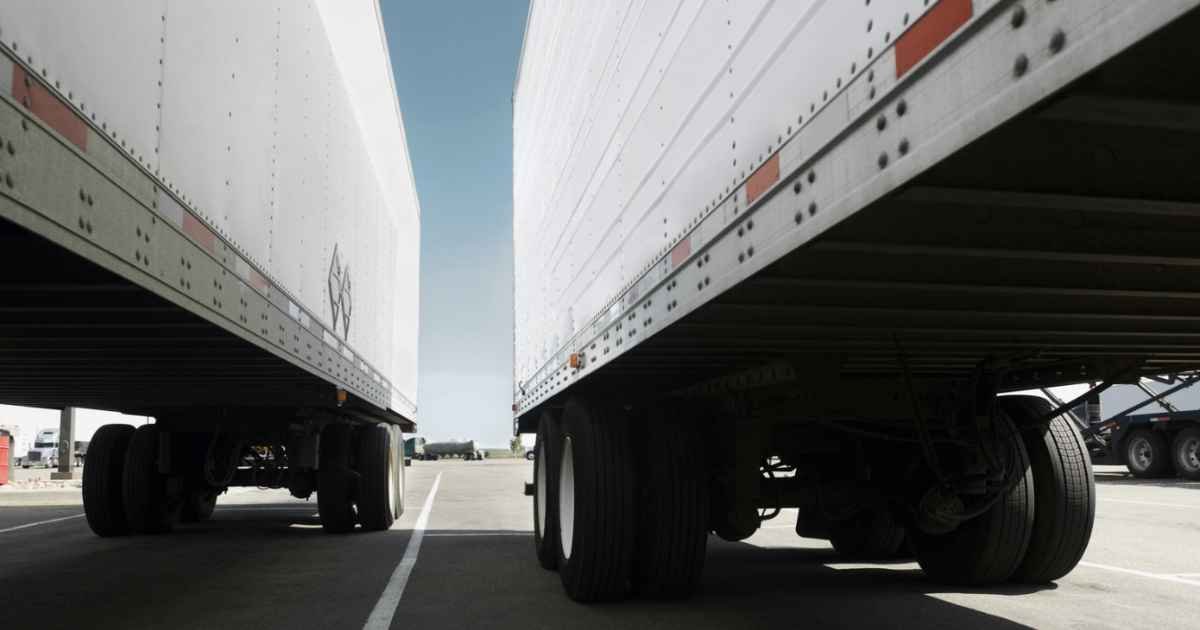
Trailers are the quiet cost center of a trucking operation. A carrier may obsess over tractor payments and fuel, yet the choice between renting, leasing and buying trailers shapes cash flow just as much. The right answer depends on how many months a year the trailer will earn money, how predictable your freight is, and how much capital you want tied up in steel.
This guide compares the three options, with current price ranges, a break-even example and the questions to ask any provider before you sign.
Key Takeaways
- Renting fits short-term needs such as seasonal peaks, overflow and storage. Monthly rates on used 53-foot dry vans commonly fall in the several-hundred-dollar range.
- Leasing typically means a commitment of 12 months or longer in exchange for a lower monthly rate.
- Buying makes sense when a trailer stays loaded most of the year and you can absorb maintenance, storage and downtime.
- Hidden costs such as rebills for damage, tire wear and roadside service often matter more than the base rate.
Rent vs. Lease vs. Buy at a Glance
| Factor | Rent | Lease | Buy |
| Typical term | Days to months | 12 months or more | Ownership |
| Upfront cost | Low | Low to moderate, sometimes a down payment | High |
| Monthly cost | Highest per month | Lower per month | No rent, but financing and upkeep |
| Maintenance | Typically provider | Often provider, depends on contract | Owner |
| Flexibility | High | Moderate | Low |
| Best for | Peaks, overflow, trial lanes | Steady contracts | High, year-round utilization |
How Much Does It Cost to Rent a Semi Trailer?
Rates vary by trailer type, age, market, and term length. Recent listings and industry data give a useful range:
- Used 53-foot dry vans: monthly rental listings on TruckPaper commonly range from about $475 to $795, depending on age and condition.
- Dry van rentals through trailer-sharing platforms: REPOWR reported a dry van rental range of $530 to $610 per month.
- New flatbeds: dealer listings show new 53-foot flatbeds renting for around $200 to $225 per day, $425 to $475 per week, or roughly $1,170 to $1,225 per month.
- Specialty trailers: refrigerated and custom trailers cost more, often well above standard dry van rates.
Short terms carry the highest per-day cost. A trailer rented by the day can cost several times more per month than the same trailer on a monthly contract.
How Much Does It Cost to Lease a Semi Trailer?
Leasing trades flexibility for a lower rate. Industry estimates put used dry van and flatbed leases at roughly $300 to $700 per month, with new standard trailers around $600 to $1,200 or more. Some dealer programs on new equipment require a down payment and terms as long as 36 to 60 months.
Ask whether maintenance is included. A lease with a lower rate but owner-paid tires and brakes can cost more over its term than a slightly higher rate that includes service.
How Much Does It Cost to Buy a Semi Trailer?
New 53-foot flatbeds and dry vans commonly list in the low-to-mid $40,000 range, based on recent dealer listings. Used trailers can cost far less, though older units bring higher repair risk.
The purchase price is only the start. Owners also cover:
- Tires, brakes, lights and suspension repairs
- Annual inspections and registration
- Insurance for physical damage
- Storage when the trailer sits empty
- Downtime when the trailer is in the shop
A Simple Break-Even Example
Suppose a new flatbed lists at $46,900 and a comparable monthly rental runs $1,170.
$46,900 ÷ $1,170 ≈ 40 months
On price alone, buying breaks even after about 40 months of continuous rental. That figure ignores financing costs, maintenance, insurance and resale value, and each of those shifts the answer. The real question is utilization. If the trailer will sit idle four months a year, the break-even point moves out by more than a year.
When Renting Makes the Most Sense
- Seasonal peaks. Retail, produce and holiday freight spike for a few months.
- Overflow. A new customer sends more loads than your fleet can cover.
- Storage. Trailers parked at a shipper’s dock serve as short-term warehouse space.
- Testing a lane. Renting lets you trial new freight before committing capital.
- Replacement during repairs. A rental keeps loads moving while an owned trailer is in the shop.
When Leasing Makes the Most Sense
Leasing fits steady freight with a known end date, such as a one-year dedicated contract. You get a lower rate than renting and keep capital free for tractors and drivers.
When Buying Makes the Most Sense
Buying fits fleets with high, year-round utilization, in-house maintenance and the cash or credit to absorb a large purchase. It also gives full control over specifications and upfitting.
Questions to Ask Any Rental Provider
- What is the rebill policy? Ask how damage and wear are assessed at return.
- Is a damage waiver available? A collision damage waiver can cap your exposure.
- Who pays for tires and roadside service?
- Is GPS tracking included? Tracking helps with detention disputes and theft recovery.
- How fast is approval? Some providers approve insurance on the spot, while others take days.
- Can I convert a rental to a lease? Useful if short-term work turns into a contract.
A Border-Market Example: Renting in Laredo
These questions carry extra weight in cross-border freight hubs, where volume swings with manufacturing schedules on both sides of the border. Laredo, in Webb County, Texas, is one of the busiest land ports on the U.S.-Mexico border, and carriers there often need extra trailers for weeks at a time rather than years.
Boxwheel Trailer Leasing shows how a provider can answer the checklist in that setting. The company operates a yard on Trade Center Boulevard in Laredo, along with border-market locations in El Paso, Texas, and Calexico, California. It offers short-term rentals for peaks and overflow, leases that typically run 12 months or longer, a collision damage waiver, and GPS tracking on every unit. Its owners, Mike Di Paolo and Mike Sindelar, built the company around avoiding surprise rebills, and it states that insurance can be approved on the spot, which often allows same-day pickup. For a Texas carrier comparing semi trailer rental options, those answers cover the rebill, waiver, tracking, and approval questions above.
Bottom Line
Rent when the need is short or uncertain. Lease when freight is steady for a year or more. Buy when the trailer will stay loaded most of the year, and you can handle upkeep yourself. Whatever you choose, compare the full cost, including rebills, maintenance, and downtime, rather than the headline rate alone.
Prices cited reflect recent listings and published industry data and change with market conditions. Confirm current rates with providers before budgeting.
Disclaimer: The information provided in this article is for general informational and educational purposes only and does not constitute professional financial, business, or legal advice. Trailer prices, rental rates, lease terms, and market conditions vary by region and provider and may change. Readers should verify current rates, contract terms, and financing options directly with providers before making decisions. The mention of Boxwheel Trailer Leasing, TruckPaper, REPOWR, or any specific company is illustrative and does not imply endorsement. The author and publisher disclaim all liability for financial losses, contract disputes, or business decisions arising from reliance on this content. Always review contracts carefully and consult qualified professionals before committing to any trailer agreement.
Explore ideas that bring clarity to confusion, our simplifying guides make tough topics feel manageable.