A growing share of buying decisions start with a question typed into ChatGPT, Gemini, or Perplexity instead of a search bar. If a business isn’t showing up in those answers, it’s losing customers before they ever reach Google. The problem is that most marketing dashboards weren’t built to measure this. Google Analytics tracks clicks and sessions. It has no column for “mentioned by an AI model and never clicked.”
That gap is why AI search visibility KPIs matter now, not in some future roadmap. They’re the numbers that tell you whether your business exists in the answers people are actually getting, separate from whether it ranks on a results page anyone still scrolls through.
What Are AI Search Visibility KPIs?
AI search visibility KPIs are metrics for how often, how favorably, and how accurately a business gets referenced inside AI-generated answers. That’s a different scoreboard than a spot in a list of ten blue links. “We rank #3 for this keyword” and “when someone asks an AI assistant this exact question, do we show up in the answer at all, and what does it say about us” are two different questions with two different answers.
Three things make these metrics behave differently than classic SEO tracking. First, there’s no fixed SERP to screenshot. The same question can return a different answer minutes apart, depending on the model, the phrasing, and even the user’s location. Second, most AI answers don’t include a clickable source, so a business can be driving real influence over a purchase decision while showing zero traffic in analytics. Third, the “ranking” concept doesn’t really apply. A brand is either woven into the answer or it isn’t, and where it sits in that answer (first, buried, absent) carries its own signal.
Why Traditional Rank Tracking Misses This Entirely
A local business owner checking their Google rankings every week might be looking at the wrong scoreboard. Search Console shows impressions and clicks. It says nothing about the conversation happening when a customer asks an AI assistant for a recommendation and gets a confident answer that never includes a link back to a website.
This is a distinct discovery channel with its own rules, not a variant of organic search. Google’s own AI Overviews, which appear directly inside search results, are a related but separate phenomenon from the answers generated by standalone chat assistants. A business can appear in one and be invisible in the other. Collapse both into a single blended “AI visibility” score and that distinction disappears, along with the ability to fix either one.
The KPIs Worth Tracking
Three numbers give a fast, realistic read on where a business stands in AI-driven discovery, and none of them require guesswork.
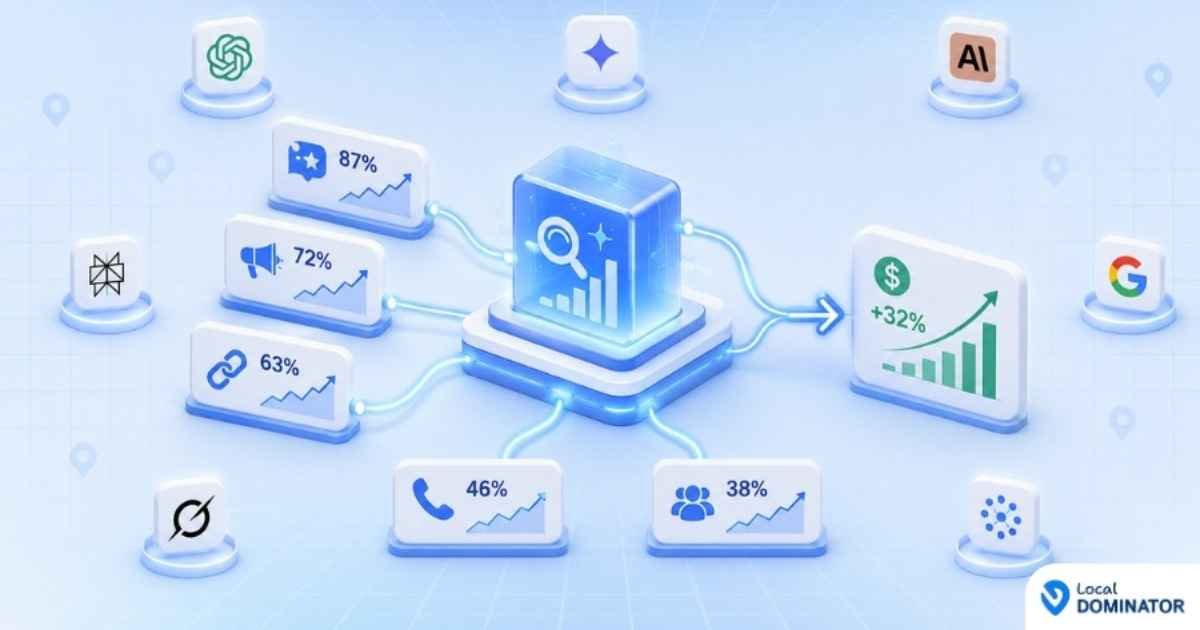
Mention rate. Out of a fixed set of relevant prompts run against an AI model, what percentage actually name the business? This is the AI equivalent of share of voice, and it’s the first number to nail down, because everything else is meaningless without a baseline.
Position within the answer. Being mentioned third in a list of six competitors reads very differently than being the first name out of the gate. Position matters even inside a single AI response, the same way it does on a search results page.
Consistency over time. A single good result from one prompt on one day proves very little, since AI answers can shift between sessions with no warning. What proves something is running the same prompt set weekly or monthly and watching whether visibility holds, climbs, or quietly erodes as competitors adjust their own content.
Those three get a business most of the way to an honest picture, but they’re not the whole scorecard. Whether an AI model is citing a brand’s own site directly or just repeating what a review site said, whether the tone of a mention actually helps or hurts, and how this connects to revenue are the harder, more useful layers sitting underneath, including how much of the average AI brand mention comes from third-party pages instead of the brand’s own site.
A Quick Example: Same Google Ranking, Different AI Outcome
Picture two competing plumbing companies in the same city, both sitting in the top three of Google’s local results for their main keyword. On paper, they look neck and neck. Run the same set of AI prompts against both and the picture can split wide open: one gets named first in nearly every answer about emergency plumbing repair, with accurate service details pulled straight from its own site. The other shows up only when a reviewer’s blog post gets referenced, with a phone number that changed two years ago.
Neither business would know this from Google Analytics or Search Console. The only way to see it is to run the prompts and look at what comes back. Bury that work inside a standard SEO report and it gets lost; track it as its own category and the gap between the two plumbers becomes obvious fast.
How to Start Tracking These KPIs This Month
You don’t need a research team to start. A workable process looks like this:
- Write down 10 to 15 questions real customers would plausibly ask an AI assistant about the category, not just the brand name. “Best dentist near me that takes walk-ins” beats “is [business name] good.”
- Run those prompts across ChatGPT, Gemini, and Perplexity at minimum, since each model pulls from different sources and returns different answers.
- Log whether the business is mentioned, where it sits in the answer, whether the details are accurate, and whether a competitor is named instead.
- Repeat on a fixed schedule and compare. One good result on one day proves nothing on its own.
Doing this manually for a handful of prompts is manageable. Doing it across dozens of prompts, multiple models, and a rolling schedule turns into a full-time job fast, and that workload is exactly why a growing number of agencies have moved it onto dedicated platforms. Local Dominator is one of the tools built specifically around this problem, running a business’s prompt set against ChatGPT, Gemini, Google’s AI Mode, Perplexity, Claude, and Grok on a recurring basis instead of a one-off check.
Whatever the setup, agencies managing more than a couple of clients tend to reach the same conclusion fast: spreadsheets tracking manual prompt runs fall apart at scale, and tools that scan every engine automatically end up doing in minutes what would otherwise eat a full afternoon every week.
FAQs
Is AI search visibility the same thing as ranking in Google’s AI Overviews?
No. AI Overviews are Google’s own summary boxes generated inside its search results page. Direct AI visibility refers to whether a business is mentioned when someone asks a standalone assistant like ChatGPT, Gemini, or Perplexity a question outside of Google’s search interface entirely. A business can perform well in one and be absent from the other.
How often should these KPIs be checked?
Weekly is reasonable for a business actively working on AI visibility, especially early on when the goal is to establish a baseline. Monthly is enough once a stable pattern is confirmed. Checking once and treating it as a permanent result is the most common mistake, since AI answers shift as models update and competitors’ content changes.
Does a business need to rank #1 in Google to show up in AI answers?
No, and this catches a lot of business owners off guard. AI models often surface businesses based on how clearly and specifically their content answers a question, along with what third-party sites say about them, not strictly on where they sit in traditional search rankings.
What’s the fastest way to get an early signal without full tracking software?
Manually run 10 to 15 realistic customer questions through ChatGPT and Gemini and note which businesses get named. It won’t scale past a handful of prompts, but it’s enough to tell whether the problem is worth solving before investing in a tracking process.
Can a bad mention hurt a business more than no mention at all?
Sometimes. A mention that sends a customer to a location that closed months ago, or describes a service the business no longer offers, can mislead someone more effectively than staying invisible ever would. Accuracy and sentiment belong on the KPI list for exactly that reason, alongside raw mention counts.
Disclaimer: The information provided in this article is for general informational and educational purposes only. It does not constitute professional SEO, marketing, or business advice. AI search behavior and platform capabilities are subject to frequent change; results may vary by industry and model. Readers should evaluate their own needs and consult qualified professionals before implementing tracking strategies. The mention of Local Dominator or any specific tool is illustrative and does not imply endorsement. The author and publisher disclaim all liability for any decisions, ranking fluctuations, or other consequences arising from reliance on this content. Always test and adapt based on your specific business context. This article does not guarantee specific visibility outcomes.
Uncover the secrets to effortless productivity—our productivity secrets make work feel like play.