British weather is not dramatic. There are no hurricanes and very little extreme cold. What there is instead is relentless damp, months of it, interrupted by just enough freeze and thaw to work into anything that holds water. That combination is harder on an outdoor structure than a proper winter would be.
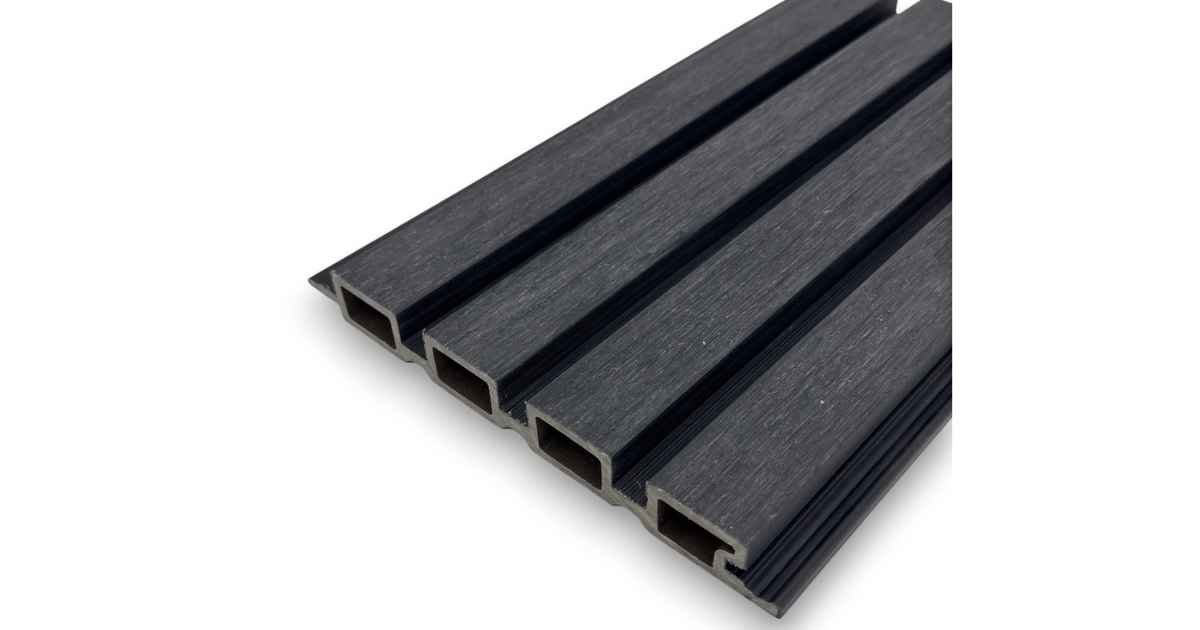
A slatted composite profile. No sealing, no staining, no annual upkeep.
Damp is the real adversary
A frozen deck is fine. A permanently wet one is not. Moisture that never fully dries out keeps timber above the threshold where fungal decay can work, and in a typical British winter the frame under a deck may not properly dry out between October and March.
Which is why ventilation matters more here than in drier climates. Air has to move under the deck. If the perimeter is sealed with no path for it, the frame sits in standing humidity for half the year regardless of what it is made from.
Take the organic material out of the equation
The most direct answer is to stop giving decay something to feed on. An aluminium joist is immune to the whole process. It does not absorb water, so freeze and thaw cycles have nothing to act on, and it holds its dimensions through every seasonal swing. A frame that does not move means boards that stay flat and screws that stay tight.
That last point is underrated. Most of what people describe as a deck “going soft” is not rot at all. It is a timber frame that has swelled and shrunk through enough cycles that every fixing has worked slightly loose.
Deal with the falls
Water needs somewhere to go. Build a dead-level deck and water will find the low spot that always exists, then sit there. A slope of roughly one in a hundred away from the building is invisible underfoot and clears the surface after rain.
Check where it goes next, too. A deck that drains neatly into a flowerbed that already floods has simply relocated the problem.
The boundary gets wet as well
Fences and garden walls take the same weather as the deck and usually receive none of the attention. Slatted cladding in a composite profile gives a boundary that handles continuous damp without swelling, splitting or needing retreatment, and it looks the same in year ten as it did in year one.
Then leave it alone
A well-built composite deck needs a wash. That is it. No sanding, no stain, no sealing, no annual weekend lost to maintenance.
Specify for the climate you actually have rather than the one in the brochure photographs, and the deck stops being a recurring job. Suppliers including Ceta Decking publish the span and fixing data you need to do that properly.
Disclaimer: This article is for general informational purposes only and does not constitute professional construction, structural, or building regulations advice. Deck design, joist spans, fixings, drainage, and ventilation requirements depend on the specific structure, site conditions, and local building regulations, and may change without notice. Readers should consult a qualified builder or structural professional, follow the manufacturer’s published span and fixing data (including for aluminium joists and composite boards), and verify any planning or building regulation requirements with the relevant local authority before construction. Any mention of specific suppliers or products (including Ceta Decking) does not imply endorsement. The author and publisher disclaim any liability for decisions made based on this content.
Looking for content that makes every read feel worth it? Explore our high-quality articles—written to inform, inspire, and keep you engaged.