Finding the right swimming Lessons For Babies And Toddlers Denver CO takes more than choosing the closest pool.
Most parents start with the same questions.
How much does it cost? How far is the drive? Does the class fit between naps and dinner?
Those things matter. But they tell you very little about what happens once your child gets in the water.
For babies and toddlers, the instructor’s approach, class structure, water temperature, safety standards and skill progression matter much more.
And there is a good reason to take the decision seriously.
The American Academy of Pediatrics (AAP) reports that drowning is the leading cause of death among U.S. children ages 1 to 4. Toddlers have the highest drowning fatality rates, and swimming pools are a common setting for drowning in this age group. The AAP recommends that children begin learning water competency after their first birthday, with the decision based on the child’s development, health and readiness.
That does not mean a few lessons make a toddler safe around water.
They don’t.
Swim lessons are one layer of protection. Close supervision, barriers around pools, life jackets when appropriate and adults who know how to respond to a water emergency still matter.
So before you enroll your baby or toddler, use these nine checks.
1. Match the Class to Your Child’s Age and Development
A 6-month-old and a 2-year-old should not be expected to learn the same things.
That sounds obvious. But program names such as “Baby Swim,” “Parent & Me” and “Toddler Swim” don’t always tell you exactly what happens in the pool.
The AAP makes an important distinction here.
For infants younger than 1, there are currently no data supporting swim lessons as a drowning-prevention measure. Babies this young do not yet have the neurological development needed to coordinate the movements required for survival swimming.
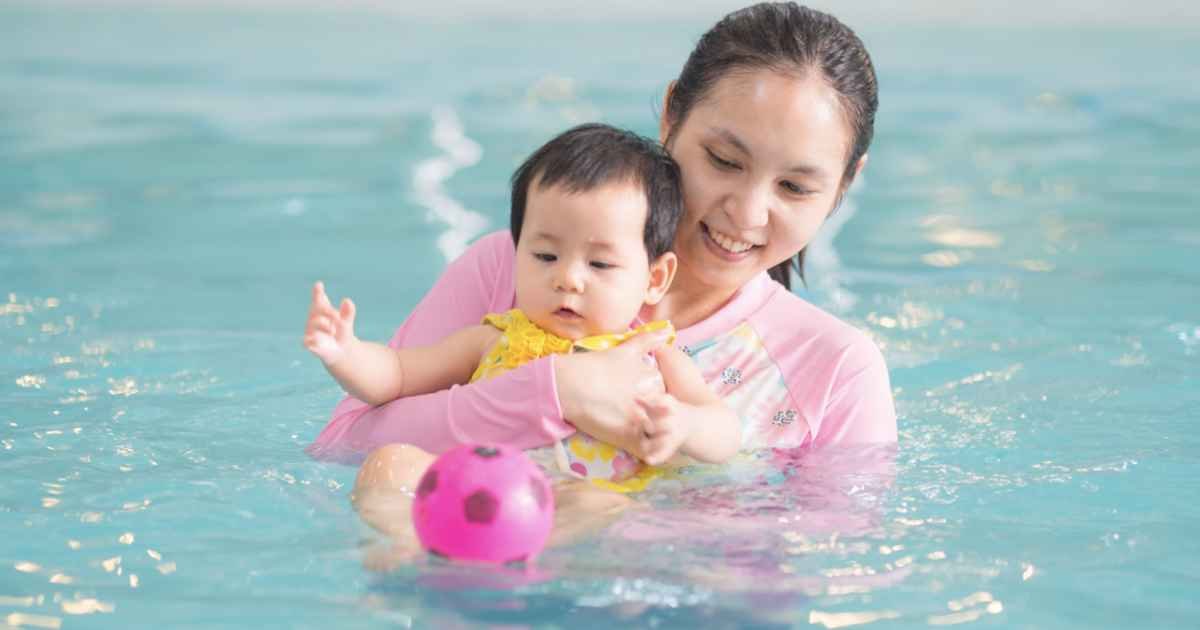
The AAP says the most developmentally appropriate goal for infant classes is an enjoyable water experience shared by the parent and baby.
After the first birthday, the goal starts changing.
Children can begin developing water competency, although progress varies greatly from one child to another.
Think of the stages more like this:
- Under 12 months: positive water experiences, parent-child interaction and comfort in the pool.
- 12 to 24 months: early water orientation and age-appropriate introductory skills.
- 2 to 4 years: increasingly purposeful movement, floating, turning, exiting and early swimming skills as development allows.
- Around 5 to 6 years: many children have the psychomotor development needed to make larger gains toward true swim competency.
Research reviewed by the AAP confirms that children ages 2 to 4 can acquire survival swimming skills. But full swimming competence develops over many lessons and alongside normal childhood development.
Bottom line: Don’t choose a class because the age printed on the schedule matches your child’s birthday.
Ask what children at that level are actually expected to learn.
2. Check the Water Temperature and Pool Environment
Have you ever watched a toddler go from happy to miserable because the bathwater got a little too cool?
The same thing happens during swim lessons.
Young children can become uncomfortable in cool water faster than adults. Once a toddler is cold, getting them to focus on floating, kicking or following an instructor becomes much harder.
Ask the school:
“What temperature do you keep the instructional pool?”
Don’t stop there.
Look at the whole environment.
Is the pool clean?
Is the deck organized?
Can instructors see the entire teaching area?
Is emergency equipment accessible?
Does the facility control access so a toddler cannot simply wander onto the pool deck?
For very young children, the environment is part of the lesson.
A beautiful pool doesn’t automatically make a safe teaching environment.
3. Look at How Much Individual Attention Your Child Gets
“Small class” can mean different things.
A parent-and-baby class with six parents and six babies is very different from six toddlers working independently with one instructor.
So don’t ask only:
“What’s your class size?”
Ask:
“How many children is one instructor responsible for in the water?”
Then ask how much direct teaching each child receives.
A child can technically be enrolled in a 30-minute lesson but spend much of that time waiting for a turn.
That matters for toddlers.
Young children learn through repetition. More individual instruction means more chances to practice the same skill while the instructor can immediately correct positioning, movement and breathing.
Private lessons can provide even more individual attention, although they are not automatically the best format for every child.
Some toddlers enjoy learning beside other children.
Others focus much better one-on-one.
Match the format to your child.
4. Look Beyond “Learning to Swim”
A toddler does not need a perfect freestyle stroke.
Water competency comes first.
The American Red Cross describes five fundamental swimming skills:
- Enter water over your head and return to the surface.
- Float or tread water for at least one minute.
- Turn over and turn around in the water.
- Swim at least 25 yards.
- Exit the water.
These are part of a broader concept of water competency that also includes understanding water hazards and knowing how to respond safely around water.
Your toddler obviously isn’t going to master all five on day one.
That’s the point.
A good program should have a progression that gradually moves children toward these abilities instead of treating “swimming” as one skill.
Ask:
“What skills does my child need to master before moving to the next level?”
Then ask:
“How do you track that progress?”
A good instructor should be able to explain both.
5. Check Instructor Training
Your toddler’s instructor needs more than the ability to swim well.
Teaching a frightened 2-year-old is its own skill.
Ask what training instructors receive.
At minimum, look for appropriate safety preparation, including current CPR and first-aid training.
Then ask about swim-specific training.
How are new instructors trained?
Do they shadow experienced instructors?
Are they trained specifically to work with babies and toddlers?
How does the school evaluate them?
How do they handle a child who refuses to enter the water?
Professional affiliations can provide another useful data point, but don’t treat a membership logo as proof of teaching quality.
Watch the instructor.
Good toddler instructors are patient but purposeful. They don’t spend the entire lesson playing, but they also don’t treat fear as misbehavior.
6. Ask Exactly How the School Handles Submersion
This deserves its own question.
Don’t settle for:
“We teach babies to go underwater.”
Ask how.
The AAP’s latest technical report raises a specific concern about repeated submersions for infants. It notes that repeated submersions used to train reflexive back floating can create negative aquatic experiences, and infant back floating has not been shown to reduce infant drowning rates.
That doesn’t mean children should never learn to put their faces underwater.
It means the method matters.
Ask the instructor:
“What do you do if my baby resists submersion?”
“How do you prepare children before going underwater?”
“Do you adjust the lesson when a child becomes distressed?”
You want a program that teaches skills without turning every trip to the pool into a fight.
A child who becomes terrified of water isn’t progressing simply because they completed the exercise.
7. Look for Progression, Not a Quick Fix
Parents understandably want results.
But be careful with programs that make swimming sound like something a toddler can master in a handful of lessons.
The AAP states that achieving swim competence and survival skills takes many lessons. Development matters too, with the psychomotor maturation that supports stronger swimming skills generally developing around ages 5 to 6. Refresher lessons can also be necessary.
So ask to see the school’s progression.
What happens after the infant program?
Where does a 2-year-old go next?
What changes when the child turns 3?
When do instructors begin working on independent swimming?
How does a child progress into stroke development?
A program with clearly defined levels makes it easier to see whether your child is actually progressing.
Consistency matters too.
A child who swims regularly gets more opportunities to practice than one who takes a short session and then stays out of the pool for most of the year.
But frequency isn’t everything.
Quality + repetition + development matter more than simply logging lesson hours.
8. Understand the Parent’s Role
For infant lessons, parents commonly participate in the water.
That’s useful for another reason: you’re learning too.
You learn how to hold your baby safely.
You see how the instructor introduces water.
You learn which cues are being used.
You can repeat appropriate skills during family pool time.
As children move toward independent instruction, the parent’s role changes.
Sometimes stepping back helps.
A toddler who constantly reaches for Mom or Dad may pay more attention when an instructor takes the lead.
But you should still know what is happening.
Ask whether parents can watch.
A viewing window, poolside observation area or visible lobby lets you see how your child responds without interfering with the lesson.
And remember: lessons never replace supervision.
The AAP recommends that an adult with swimming ability stay within arm’s reach of infants, toddlers and weak swimmers around water. That adult should be focused on supervision rather than phones or other distractions.
9. Ask for an Assessment Before Picking a Level
Age doesn’t always equal swimming ability.
Two 3-year-olds can have completely different relationships with water.
One may have spent every summer in a backyard pool.
The other may have never willingly put their face underwater.
Putting both children into the same class based only on age can create problems.
The experienced child gets bored.
The nervous child gets overwhelmed.
An assessment gives the instructor a chance to see where your child actually starts.
They can look at:
- Comfort entering the pool
- Reaction to water on the face
- Ability to follow instructions
- Floating experience
- Body position
- Kicking
- Previous swimming experience
- Comfort separating from a parent
Then the school can recommend an appropriate starting point.
If an assessment is available, use it.
The Safety Question Parents Should Ask
Here’s one question worth asking every swim school:
“What do you tell parents their child can and cannot safely do after completing this level?”
Listen carefully to the answer.
No responsible swim program should tell you that lessons make a baby or toddler “drown-proof.”
They don’t.
In 2024, 1,075 U.S. children and young people under age 20 died from unintentional drowning, according to data cited in the AAP’s 2026 technical report. Children ages 1 to 4 remain the highest-risk childhood age group.
Swimming ability is one layer of protection.
Supervision is another.
Pool barriers are another.
Life jackets are another.
Knowing CPR is another.
The safest approach uses several layers together.
Red Flags to Watch For
Keep looking if a program:
- ❌ Promises to “drown-proof” your baby
- ❌ Cannot explain instructor safety training
- ❌ Forces repeated submersions despite distress
- ❌ Cannot explain how children progress between levels
- ❌ Gives every child the same instruction regardless of ability
- ❌ Cannot explain its emergency procedures
- ❌ Makes it difficult for parents to observe lessons
- ❌ Promises independent swimming after a fixed number of lessons
One red flag doesn’t always mean a school is unsafe.
But vague answers to basic safety questions should make you look closer.
Group vs. Private Swimming Lessons for Babies and Toddlers
This is another decision parents often make based on price alone.
Don’t.
Group lessons work well when:
Your child enjoys other children.
They can wait briefly for turns.
You want parent-child interaction.
You prefer a social introduction to swimming.
Private lessons work well when:
Your child needs more individual attention.
They are fearful around water.
They become distracted in groups.
They already have skills that don’t fit neatly into a standard level.
They need more focused practice.
Neither format automatically produces a better swimmer.
The quality of instruction and fit with the child matter more.
Quick Tips for Lesson Day
A good swim program can still turn into a terrible Tuesday afternoon if the timing is wrong.
A few things help.
Work around naps.
A tired toddler doesn’t care how good the instructor is.
Don’t arrive starving.
Give your child enough time to eat before the lesson without putting them in the water immediately after a large meal.
Know the diaper policy.
Ask the facility what type of swim diaper it requires before the first class.
Bring warmth for afterward.
Have a towel and dry clothes ready.
Use the instructor’s language at home.
If the instructor uses a particular cue before water touches the face, use the same words during bath time when appropriate.
Don’t compare children.
The toddler in the next lane may float independently while yours refuses to let go.
That doesn’t mean the lesson is failing.
Progress at this age can be uneven.
Choosing Swimming Lessons for Babies and Toddlers in Denver, CO
For families comparing swimming lessons for babies and toddlers in Denver, CO, the same nine-point checklist applies.
But there is one local factor worth considering: consistency.
A year-round indoor program allows Denver-area families to continue lessons through colder months rather than treating swimming as a summer-only activity.
One local example is Blue Dolphin Swim School in Westminster, northwest of Denver. Its published program information provides several details parents can compare against this checklist rather than simply relying on marketing claims.
The school offers infant programming for children from about 4 to 24 months. Its broader progression moves from infant instruction into Learn to Swim programs for ages 2 to 7, followed by intermediate and advanced programs.
It also publishes an option for one-on-one instruction and offers a free swim assessment for families who aren’t sure where their child should start.
Parents can observe lessons from designated areas, including the lobby and viewing windows, according to the school’s current information.
Those are useful facts.
But don’t choose any school based on four facts alone.
Use the rest of the checklist too.
Ask about instructor credentials.
Ask about water temperature.
Ask how submersion is handled.
Ask how progress is measured.
Ask what happens when your child becomes frightened.
And watch a lesson if possible.
The goal isn’t to find the swim school with the longest list of features.
It’s to find the program whose teaching method fits your child.
Questions to Ask Before You Enroll
Save these on your phone before visiting a swim school:
What will my child learn at this level?
How many children does each instructor teach at once?
What CPR and first-aid training do instructors have?
How do you handle submersion?
What happens when a child cries or refuses a skill?
How do you measure progress?
When does a child move to the next level?
Can parents observe lessons?
Do you offer an assessment before placement?
What water-safety skills are included?
Those questions will tell you far more than a price sheet.
The Bottom Line
The best swimming lessons for babies and toddlers in Denver, CO aren’t necessarily the closest classes or the ones promising the fastest results.
Look for age-appropriate instruction, trained teachers, individual attention, a clear skill progression and an approach that respects your child’s development.
And keep expectations realistic.
The AAP recommends beginning swim lessons after the first birthday, based on the child’s readiness. It does not recommend infant swim lessons as a proven drowning-prevention measure for babies younger than 1. Most important, even a child who swims well still needs close adult supervision around water.
Your goal isn’t to create a “drown-proof” toddler.
It’s to help your child build water skills, confidence and good habits one lesson at a time.
Disclaimer: The information provided in this article is for general informational and educational purposes only and does not constitute professional medical, safety, or parenting advice. Drowning prevention requires multiple layers of protection, and no swim program can make a child “drown-proof.” Readers should consult qualified swim instructors, pediatricians, and water safety organizations for guidance specific to their child. The mention of Blue Dolphin Swim School, the AAP, or any specific organization is illustrative and does not imply endorsement. The author and publisher disclaim all liability for accidents, injuries, or decisions arising from reliance on this content. Always provide close, undistracted adult supervision around water.
Browse through wisdom that feels like self-care, our nurturing content looks after your mind and mood.