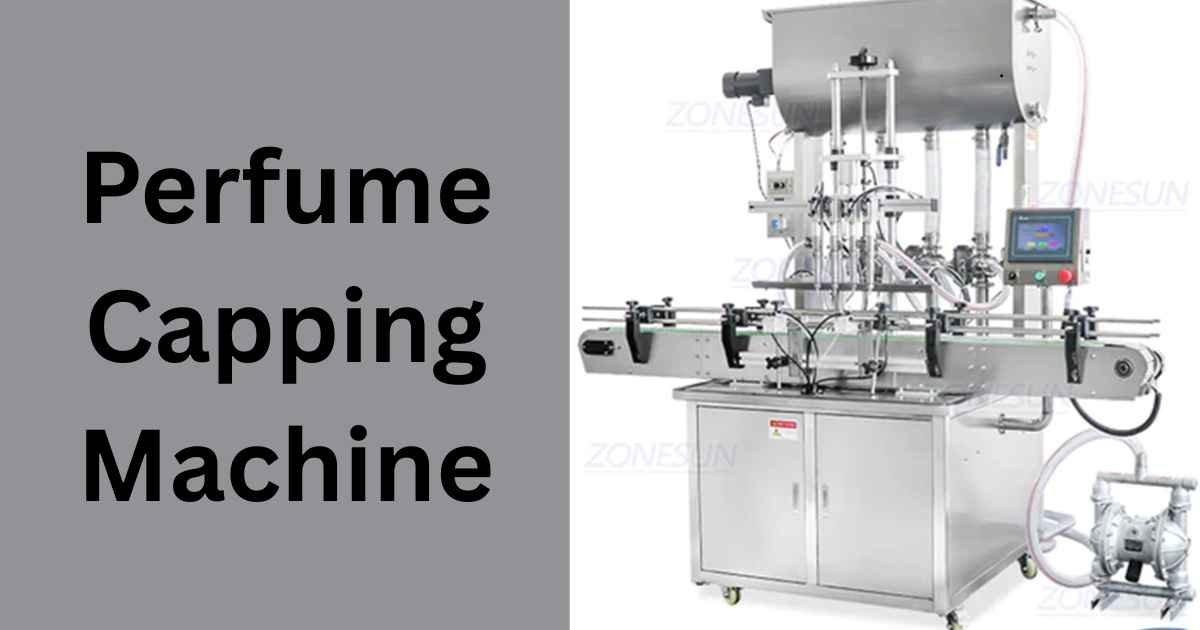
Walk onto any perfume production floor and you’ll notice the capping station is usually where operators hover the closest. It’s not the filling stage or the labeling stage that causes the most headaches — it’s getting a cap onto a bottle correctly, every single time, without cracking glass or leaving a seal that fails during shipping. A perfume capping machine handles this, but choosing the right one depends on factors most buyers don’t think about until after they’ve already made a purchase they regret.
This guide takes a practical, decision-focused approach: what actually differentiates one capping machine from another, how to match a machine to your specific bottles and caps, and what questions to ask a supplier before you commit.
Start With Your Cap, Not the Machine
Most buyers start by researching machines. A better starting point is your actual closure design, because the cap type dictates which machines are even viable options.
Screw caps need a chuck or rotary head that applies rotational torque. Snap-on caps need a press mechanism instead — twisting a snap cap can scratch or crack decorative finishes. Crimped collars, common on spray pump assemblies, need a crimping head entirely separate from torque-based capping. Magnetic caps, increasingly popular in premium fragrance packaging, sometimes need no active capping force at all, just precise placement.
If you’re developing new packaging alongside your production setup, it’s worth checking with your capping equipment supplier before finalizing the cap design. A beautiful cap concept that no standard machine can handle turns into a costly custom-tooling problem later.
The Torque Question Nobody Asks Early Enough
Every perfume capping machine that screws caps on needs torque control, but the range and precision of that control varies enormously between machines at different price points.
Entry-level machines often have a single adjustable torque setting for the whole run. Mid-range and higher-end machines allow torque profiles saved per cap type, so switching between two products with different caps doesn’t mean manually recalibrating the machine each time.
This matters more than it sounds. A torque setting that’s correct for a heavy glass overshell cap will crush a lightweight plastic snap cap. If your product line includes more than one cap style — which most fragrance brands do — a machine without programmable torque memory turns every changeover into a manual guessing exercise.
Glass Bottles Change the Calculus
Unlike plastic bottling lines, where a slightly aggressive capping force just means a tight lid, perfume capping deals almost entirely with glass. Glass necks can chip or crack under uneven pressure, and irregular or ornate bottle shapes — common in fragrance packaging specifically because brands want shelf differentiation — make consistent alignment harder than it looks.
A few things matter specifically because of glass:
- Centering accuracy. If a bottle isn’t perfectly centered under the capping head, torque gets applied unevenly, increasing the chance of a chipped neck.
- Cushioned gripping surfaces. Machines with hard metal-on-glass contact points are more likely to cause surface damage than those with cushioned or adjustable grippers.
- Slower ramp-up speed. Capping heads that engage gradually rather than snapping to full torque instantly reduce shock stress on the glass.
None of this shows up on a spec sheet as clearly as throughput numbers do, which is exactly why it gets overlooked until a production run starts producing chipped necks.
Throughput Is Only Half the Speed Story
Suppliers quote capping speed in bottles per minute, and it’s tempting to buy based on that number alone. But real-world output depends just as much on changeover time as raw capping speed.
A machine rated for 200 bottles per minute that takes 45 minutes to reconfigure between bottle shapes will underperform a 120-bottle-per-minute machine with five-minute changeovers, if your production involves frequent SKU switching — which is common for fragrance brands running seasonal releases or multiple product lines on shared equipment.
Ask suppliers specifically about changeover time between your different bottle and cap combinations, not just the machine’s top rated speed on a single format.
Where Semi-Automatic Still Makes Sense
Full automation isn’t always the right call, even for growing brands. Semi-automatic capping machines remain the better choice when:
- Production volume is under roughly a thousand bottles a day
- The product line includes frequent small-batch or limited-edition runs
- Packaging changes often enough that automated changeover time would eat into any speed advantage
- Capital budget is tight and a fully automatic rotary system isn’t justified yet
The point where automatic capping starts paying for itself is usually when labor cost from manual or semi-automatic capping exceeds the equipment’s amortized cost — which depends heavily on local labor rates and production volume, so it’s worth running the actual numbers rather than assuming bigger is always better.
Questions Worth Asking Before You Buy
- Can the machine handle every cap type currently in our product lineup, not just the primary one?
- What’s the changeover time between our specific bottle shapes, tested with our actual samples?
- Can torque settings be saved and recalled per product, or does every changeover need manual recalibration?
- What contact materials touch the bottle and cap, and are they suitable for alcohol-based fragrance residue?
- What does a service and spare parts arrangement look like, particularly for gripper and chuck components that wear with use?
A supplier willing to run a trial with your actual bottles and caps — not a similar demo product — is a strong signal they’re confident in the machine’s real performance rather than just its spec sheet.
Final Thoughts
The right perfume capping machine isn’t the fastest one or the most automated one — it’s the one that matches your specific caps, bottle shapes, and production volume without turning every changeover into a manual recalibration. Torque precision and glass-safe handling matter more for long-term product quality than headline throughput numbers, and changeover time often has a bigger real-world impact on output than the machine’s rated speed.
Before signing off on a purchase, insist on a trial run using your actual packaging. Bottle shape and cap material affect grip and torque behavior enough that a demo with different products won’t tell you how the machine will actually perform on your line.
Disclaimer: The information provided in this article is for general informational and educational purposes only. It does not constitute professional equipment purchasing, engineering, or production advice. Cap and bottle specifications, torque requirements, and machine suitability vary widely; always test machines with your actual packaging before purchasing. The author and publisher disclaim all liability for any production issues, equipment damage, or financial losses arising from reliance on this content. This article does not endorse any specific manufacturer or machine model. Consult with qualified suppliers and conduct thorough trials before making a purchase.
Start building your future now—our foundational wisdom sets you up for lasting success.